Getting started
Reformer Pilates for beginners: your first two weeks
Reformer Pilates for beginners is a guided way to build strength, steady your back and learn every move with a coach beside you, even if you have never taken a class. The reformer is a sliding carriage with springs, so the machine supports you while you learn. At Brightside Studio, a first class runs 25 minutes at 6:15 AM, starts with a 10-minute form check, and ends with a plan for the mornings in between.
Below: what the machine actually does for a beginner, what happens in a first class, what the research says about back pain, and how often to come.
Reformer Pilates for beginners: why the machine helps
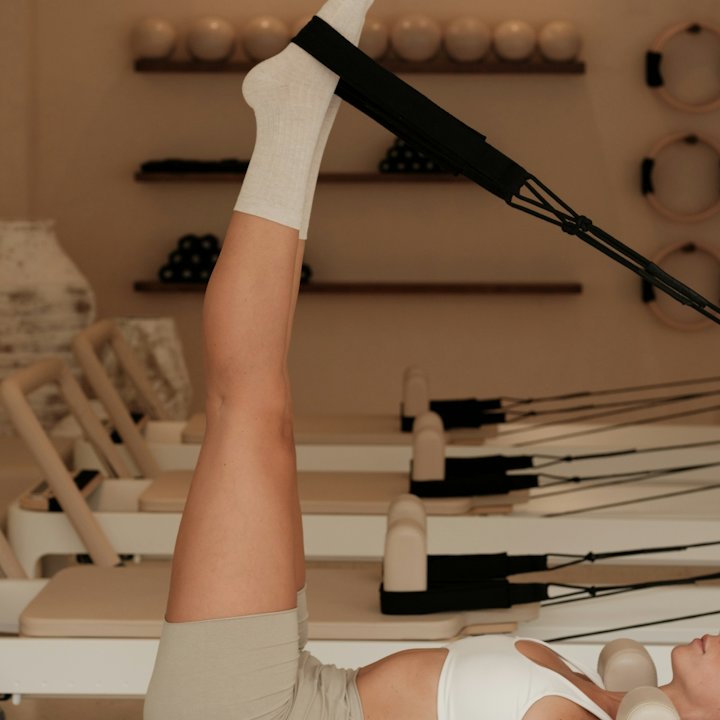
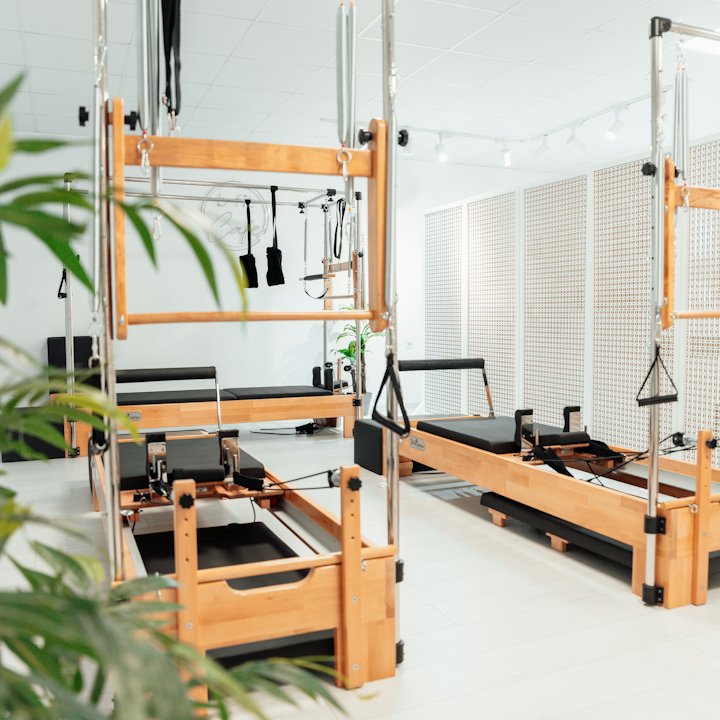
From the doorway, a reformer looks like a lot: a long frame, a carriage that slides, straps, a footbar and a row of springs. Up close, that equipment is the reason reformer Pilates works so well for beginners. The springs add resistance or support depending on how the coach sets them. A move you could never hold on a mat becomes one you can do with control on your first morning.
Cleveland Clinic's guide to Pilates puts it plainly: freeform Pilates can actually be harder on the back than using a reformer. That matches what we see in the studio. The carriage keeps you lined up, and the coach changes the springs so the move fits your body today, not the body in a video.
The other reason is pace. Every reformer move starts small and gets bigger only when you're ready. Nobody jumps, nobody sprints, and nothing depends on how fit you were ten years ago.
You lie down, press, slide and control the way back. That control is the whole workout, and a beginner can practice it from the first rep.
Coaches also love the reformer for one simple reason: we can see everything. When your hips tip or your shoulders creep toward your ears, the line of the carriage shows it right away, and a quick cue fixes it before it becomes a habit.
What happens in your first reformer Pilates class
Your first reformer Pilates class at Brightside has three parts, and none of them involves being thrown in the deep end. Arrive 10 minutes early. Your coach meets you at the front desk for a form check, a short conversation about your back, any old injuries, what feels stiff in the morning and what you want from the next two weeks.
Then the 25-minute class itself:
- Footwork. Lying on the carriage, pressing out and back. This is where you learn what the springs feel like.
- Bridging and core. Small, slow moves that wake up the muscles around your spine.
- Arms in the straps. Upper body work while your back stays supported.
- A short stretch. So you leave looser than you arrived.
If you have never been on a reformer, your coach shows every new move once, then sets your springs before you try it. You will hear a lot of small cues: soften your knees, lengthen the back of your neck, breathe out as the carriage moves. Those cues are the coaching. Questions are welcome in the middle of class, and so is sitting a move out.
Classes stay small because we have 12 reformers, so there are never more than 12 people in the room. Your coach can see you, learn your name and adjust your springs between moves.
You walk out at 6:40 with a written plan: two or three short moves for the mornings between classes. Most of the work of starting is simply knowing what to do next, and the plan answers that.
You don't have to be flexible to start Pilates
Worried you'll be the only beginner in the room, the one who can't touch her toes? That fear keeps more people out of Pilates than anything else, and it rests on a mix-up. Flexibility is the result of Pilates, not the entry fee.
Every move in a beginner reformer class has an easier version. If your hamstrings are tight, the coach shortens the straps or bends your knees. If a stretch pulls, the springs change so the carriage moves less. You work at your range today, and that range grows week by week.
The room helps too. At 6:15 AM the class is full of parents squeezing in one thing for themselves before the day starts. Nobody is performing. Since we opened in 2019, 340 members have started with our beginner series, and every one of them had a first class.
What changes quickly is how the moves feel. The second time through footwork, the springs feel familiar. By your fourth class, setting up the carriage feels routine instead of new, and your attention can go where it belongs: on the movement itself.
The only real requirement is showing up. A coach takes care of the rest.
Is Pilates good for back pain? What the research says
Back pain is the reason many of our members walk in, so the honest answer matters more than a hopeful one. A 2014 systematic review in PLoS One looked at the trials on Pilates for people with chronic low back pain. The review found Pilates gave greater improvements in pain and function than usual care and general physical activity in the short term, between 4 and 15 weeks. The same review found no clear difference at 24 weeks, and found results similar to massage and other forms of exercise.
What does that mean for you? Pilates is a good way to move with a sore back, and the benefit comes from doing it regularly. No single class fixes a back. What helps is steady, coached movement over weeks, which is exactly what a beginner series is for.
In class, that looks like slow movement with support. Your coach keeps your spine in positions that feel comfortable, uses the springs to take load off when needed, and swaps any move that doesn't feel right for you that morning. Nobody asks you to push through pain.
Two cautions. Pilates is not a medical treatment, and a coach is not your doctor.
If your back pain comes from an injury, a disc problem or anything a doctor is treating, check with them before your first class. Then tell your coach at the form check, so every move is set up for you.
Reformer Pilates for beginners: how often to come
Cleveland Clinic suggests that doing Pilates three to five times a week is great, as part of a balanced routine that also includes strength and cardio. For most busy parents, three to five studio classes a week is not realistic, and it doesn't need to be.
Here is how we set up a beginner's week. Two 25-minute classes, Tuesday and Thursday at 6:15 AM, with a coach. On the mornings in between, the short moves from your written plan, done on the floor at home in a few minutes. Add a walk with the kids or the dog, and the week covers more than you'd expect.
Imagine two weeks from now. You know the footwork without looking at anyone. You know which spring setting feels right. Your back has had four coached classes and a handful of short mornings at home instead of none.
That is the point of the first two weeks: a routine you can keep. Consistency beats intensity here. Two short classes you actually make will do more than five long ones you keep missing, which is why our beginner series is built around the two mornings the studio runs, not an ideal week nobody can keep.

How to start Pilates as a beginner at Brightside
Starting is simpler than the reformer looks. Pick a morning, Tuesday or Thursday at 6:15, and book your first class. Arrive 10 minutes early for your form check, take the class, and leave with your plan.
There are three ways to start. A single class is $28, and that $28 counts toward The 6:15 Start if you join within 7 days. The 6:15 Start is four classes in two weeks, the form check and your written plan, for $79. The 6:15 Start Plus adds two private sessions for $219, for anyone who wants one-to-one help with a sore back.
Not sure yet? Come to your first two classes of The 6:15 Start. If Brightside isn't for you, tell us and we refund it in full. You can also read how the first two weeks work on our home page, or start with a look at the studio.
What to bring: comfortable clothes you can move in and a water bottle. Your coach handles the rest, from the spring settings to the plan you take home. And if your back has been the reason you keep putting this off, say so at the form check. Every move can be set up around it.
Every class has 12 spots, one per reformer.
Your first class is one morning away.
Tuesday or Thursday at 6:15 AM. 25 minutes. All levels, with a coach beside you.
Book your first class